Showing posts with label Evangelism. Show all posts

Wednesday, March 4, 2026

Christ and Culture on Repeat


Rumblings about the decline in Southern Baptist (SBC) numbers have once again created a kerfuffle. Mark Terry wrote a piece in SBC Voices, titled “Why is the Southern Baptist Convention Declining?” James Emery White responded with “The SBC Free Fall” in Church & Culture. 

The purpose of this short piece is to respond to the advice of James White.

White postulated three reasons for the decline in the SBC:

  • Outdated Evangelistic Methods. …Evangelistic methods that worked in the late 20th century often don’t resonate in today’s secular or pluralistic culture. ...
  • Cultural Disconnect. Many Millennials and Gen Z feel alienated by a perceived blending of Christian identity with partisan politics, and cultural rigidity on gender roles and race. ...
  • Internal Conflict and Scandal. The SBC has faced many high-profile controversies, including a sexual abuse crisis and allegations of cover-ups, internal disputes over women in ministry and leadership roles, and theological infighting over tertiary issues. ...
As a grateful Southern Baptist, saved in my childhood and joining the SBC at the age of 35, I would like to provide a different perspective on each of these three points of James White.

  • Outdated Evangelistic Methods: Biblical Methods are the only methods that work—this statement is always true and will never fail. Compartmentalizing methods into chronological or sociological eras is a fallacious way to ask the question. If we believe in the sufficiency of Scripture for teaching about the gospel, we must likewise believe Scripture to be sufficient in teaching about how to spread the gospel (evangelism) and how to receive the gospel (conversion). Any cultural taint only manifests an integrationist position in the author and simultaneously diminishes the authority of Scripture in speaking about evangelism. What resonates with our culture does not matter. What matters is how the Holy Spirit convicts the heart of man and produces true repentance in his heart. Culture is truly a tertiary matter. What matters is the biblically driven proclamation of the gospel no matter what culture says and does—Yes, even to the point of burning evangelists alive!
  • Cultural Disconnect: The gospel is automatically culturally compelling to the elect. Trying to cozy up to Gen Z is a losing proposition from the start. The gospel is self-authenticating and imminently impactful to the heart of man. The gospel of Christ was defined by the Apostle Paul as “the power of God unto salvation” (Romans 1:16). Accommodating to culture has never been and will never be “the power of God unto salvation.” Any attempt to blend the gospel with culture nullifies the authority of Scripture and automatically reshapes the message of the gospel into something else. In numerous places in the Bible God says, “Do not add to My words,” and “Do not subtract from my words.”

  • Internal Conflict and Scandal. Proverbs 6:19 explains a seventh thing which the Lord hates, “One who sows discord among brethren.” There are persons who are obsessed with sowing discord among brethren. In the case of the SBC, it is the largest Protestant denomination in the U.S., thus it has a big bullseye on its back. Contentious and discordant persons, who are guided by the deeds of the flesh (see Gal 5:19-21), are constantly seeking to say “Ah-ha. Our eyes have seen it” (Psa 35:21). They cannot wait to ferret up the next issue to make a name for themselves. It would be better if they were out evangelizing and discipling others, and letting the Lord take care of His own servants (Rom 14:4).

More than anything, it is vitally important that the words of Christ be the foundation upon which every house is built. The words of Christ will never fail. Christ will prevail.


The winds and waves of culture may do what they please. We take our stand on the words of the word of God! 


Wednesday, January 10, 2024

Charting Mission Drift in the Local Church


Even while there are starbursts of hope on the horizon, mission drift should never be taken lightly. Shifting away from the biblical teaching and practicing biblical evangelism are symptomatic of and precedent to identifiable doctrinal drift. When a pastor or church no longer esteems direct evangelism appropriate, it is usually disguised by emphasizing relationship evangelism or servant evangelism. Non-participation in direct evangelism easily morphs into antagonism to direct evangelism. While there is a warning here, at the end of this blog I highlight four encouraging trends displaying that God is truly at work in His church.

This topic is like trying to make sense of bowl of Jambalaya. There are so many interacting and moving parts that it becomes difficult to comprehend the blending and rehashing. The goal of this short blogpost is to introduce four overlaid charts that seek to develop a framework for identifying the problem of evangelistic drift. Each of the four charts introduces another layer of consideration into this topic. 

Chart One introduces the lifecycle of an organization. Chart Two applies the lifecycle terminology to the development of a denomination, from evangelism and church planting all the way to disintegration. Chart Three inserts red boxes to show how views of evangelism overlay over the lifecycle of an Evangelical church movement. Chart Four shows how institutional churches try to tap the zeal and power of an evangelistic fervor of the “incipient stage” with “church planting,” or the growth of the “formalizing state” with “church growth.” Other layers could also be added to this framework. It is the view of this author that what is needed is a return to New Testament evangelism in theory and practice at every stage of church life. It is only by following the teachings and examples of the Bible that God’s love is shed abroad in believing hearts. 

“And not only that, but we also glory in tribulations, knowing that tribulation produces perseverance; and perseverance, character; and character, hope. Now hope does not disappoint, because the love of God has been poured out in our hearts by the Holy Spirit who was given to us.” Romans 5:3-5.

This tribulation produced love from God then flows through the entire church when they are zealously obedient to Christ’s Great Commission.

Chart 1: Five Stages in Organizational Lifecycle


The chart above displays the five stages of a social institution, as described by David Moberg in his book, The Church as a Social Institution. These five stages are descriptive of organizational reality. They will provide the basis for understanding the rise and fall of the local church. Let it be clear that if a local church lasts 100 years in the United States, it is an unusual church. This is especially so if it maintains its original purposes and goals after 100 years. Most churches close long before they achieve their 100-year mark.

This fact begs the question: have there not been Baptist churches in the United States since the State of Providence was founded in 1638, how can it be that churches do not survive, and new ones must be planted? The reason is mission drift and doctrinal drift. After these two forms of mildew eat away the heart of the churches where they thrive, the leave a hollow shell that eventually closes.

The five stages in the lifecycle of an organization are:

  • Incipient Stage: Typified by zeal and fervor, founding members will cross rivers and plains to preach the gospel to one and all. Revival fires glow. The Holy Spirit is breathing out a new work of God.
  • Formalizing Stage: Typified by hard working pastors who gather congregations together, continuing in the footsteps of their founders. They boldly evangelize and gather members into churches.
  • Administrative Efficiency: Sometimes one or two generations removed from the founders, the new pastors apply new methods and principles of administration to best shepherd the flock of God in their care. There is no need for outsiders to be brought in since the churches are healthy and prosperous from the efforts of the founding generations.
  • Institutionalization: As evangelism wains, so love diminishes, and zeal for spiritual things becomes rare. Soon the church becomes introverted and works-oriented as it focuses on its own health and survival. Love grows cold. Church leaders run the church like businessmen do a business. The Spirit slowly says, “Ichabod.”
  • Disintegration: The church knows that it is dying. They may have money in the bank. They may control sizable real estate. But soon the numbers diminish, and they are no longer able to pay the light bills. Desperation mounts to maintain the institution that they once were. This is a sad time for any church.
  • Political Assimilation: To Moberg’s five stages I have added 5-B. There are some churches that defy the funeral home envisaged in this last stage. When a church receives support from taxes, they can continue indefinitely no matter how many people do or do not attend that church. The giving to the church is less important. Practicality speaking, evangelism is less important. This is where State-Churches do not follow the five-stage paradigm of Moberg.

Every local church fits somewhere on this paradigm. It is helpful to begin to evaluate where we are so that we can best return to the biblical teachings and methods.

Chart 2: Stages of Denominational Power


As churches walk their way through their own history, each stage marks difficulties and opportunities for them. Early church planters are unknown in their towns and cities. They are like outcasts seeking to start another church in a town that may be filled with other churches (in the U.S. for example). But once a new church begins to grow, the church planter gain recognition and respectability. If God continues to bless their work with faithful members his spiritual “power base” increases.

Soon the church planters may find themselves in conflict with the pastors of institutionalized churches that are waning. If church planters are more spiritually oriented (as the paradigm suggests), they may lock horns with pastors that have slipped down the slippery slope of compromise. It may appear to be generational conflict, but on a deeper level, it may be a Great Commission conflict, and even a doctrinal conflict.

Meanwhile, the institutional churches generally hold the levers of power. They control the finances and board rooms of the institutions created by prior generations of churches, such as conventions, schools, and even publishing houses. The older pastors understand church politics, and they do not intend to give up that control.

Are these battles only generational or institutional? It seems like there is an underlying evangelistic or spiritual component that may ignite or fuel these battles to epic proportions.

Chart 3: Stages of Evangelistic Philosophy


Before a church becomes a dying church, biblical evangelism has long been abandoned. Evangelism may be discussed in the hymns and Sunday School curriculum, but it is no longer practiced. There is a key point in a local church’s lifecycle when aggressive evangelism is considered counter-productive and unnecessary.

The church did not start out that way. Most Evangelical churches are founded by Evangelists through Revival Movements. Souls were aggressively sought. Direct evangelism was encouraged from the pulpits and practiced in the pews. But as the church budget grows and church staff swells, there is often a moving away from the urgencies of evangelism.

Culture begins to encroach into church evangelism methods. Mass marketing and client-management tools replace personal evangelism. Sermons no longer plead for souls to be saved. The need for a healthy weekly offering weighs heavy on the heart of the pastor as he prepares his sermons. Prominent people from town may now attend his church. The pressures of success are real. It takes an unusual pastor to keep the bow of the ship of the church clearly pointed toward Christ’s Great Commission. Praise God for men such as these!

On the other hand, ungrounded leaders listen to the sirens of culture calling out to ship’s captains, causing them to veer towards spiritual reefs. 

Chart 4: Attempts to Regain Patterns of Growth


Some local church sociologists may market a “form of godliness” (2 Tim 3:5) of techniques of church planting or church growth to institutional churches. These techniques fit with the evangelistic philosophy of institutional churches. However, these culturally relevant methodologies often lack the two essential components for power in witness:

  1. The power of the word of God, Hebrews 4:12-13: “For the word of God is living and powerful, and sharper than any two-edged sword, piercing even to the division of soul and spirit, and of joints and marrow, and is a discerner of the thoughts and intents of the heart. And there is no creature hidden from His sight, but all things are naked and open to the eyes of Him to whom we must give account.”
  2. The power of the gospel of Christ, Romans 1:16: “For I am not ashamed of the gospel of Christ, for it is the power of God to salvation for everyone who believes, for the Jew first and also for the Greek.”

The culturally relevant methods have all the trappings of earthly success, but they lack Holy Spirit power. They also lack the love of God, which God sheds on His people as they evangelize through persecution for the gospel.

Natural means yields natural success. Spiritual means produces spiritual success. Earthly means yields temporal success. Divine means produce eternal success. Regenerate Christians have been gifted the “power of God unto salvation to the Jew first and also to the Greek.” Why would we trade in this most powerful weapon for the broken cisterns of human methods.

God blesses His Word. He blesses His Gospel. He blesses biblical evangelism.

Several Amazingly Encouraging Trends

As Moberg’s five stages of organizational life are studied, there are trends that show that Southern Baptists are breaking the mold of mainline U.S. churches. The first major miracle was the Conservative Resurgence that took place especially from 1980 to 1990. As the recipient of a Doctor of Philosophy from the Southern Baptist Theological Seminary, graduating in 2001, I became a student after Dr. Albert Mohler led significant changes at the school. I am deeply grateful. In the majority of U.S. seminaries, I would have had to fight for inerrancy, the virgin birth, and the substitutionary atonement in most doctoral seminars or colloquia. My degree would have had little to do with biblical evangelism and a lot to do with sociology of religion. Southern Seminary was both rigorous and a breath of fresh air in my academic preparation. The six SBC seminaries remain an encouraging modern trend.

The six seminaries takes biblical inerrancy seriously and are firmly planted on the Baptist Faith and Message 2000. There is brilliant hope for the future.

The second positive trend that I have experienced for over 25 years is that SBC leaders are constantly seeking out young talent. When Dr. Jason Allen was hired as President of Midwestern Baptist Theological Seminary, where I taught on campus for 19 years, I was truly impressed. The SBC machinery of churches, associations, entities, committees, boards, conferences, conventions, and fellowships allows young talent to be noted, trained, and deployed, some into prominent leadership roles. The highly qualified Dr. Allen came to Midwestern as President at the age of 35.

A third trend regards the North American Mission Board’s (NAMB) Church Replanting ministry. Their Replanting webpage (https://www.namb.net/church-replanting) is devoted to replanting and revitalizing struggling churches. Included on this page is Mark Clifton’s weekly podcast, “Mondays with Mark.” This emphasis shows that NAMB takes the reality of organizational lifecycles seriously, to the point where they have implemented a strategy to address this threat.

Fourthly, NAMB's new "Evangelism Kit" (https://www.namb.net/evangelism/kit/) is an amazing breakthrough in mobilizing Southern Baptists all across the U.S. to be involved in New Testament evangelism. This kit marks a full return to incipient stage evangelism by affirming and encouraging New Testament principles of evangelism.

Additionally, there are some amazingly positive trends on the mission fields of the world where Evangelical missionaries are drawing from the raw material of the New Testament to develop powerful movements of evangelism and discipleship. While a study of these trends is beyond the scope of this paper, they only add to the encouragement of God’s hand at work.

And yet drift happens and is happening. Like Jambalaya, these charts exemplify many moving parts in organizational stages and mission drift in the life of the local church. What might be some takeaways? Here are four recommendations:

  1. Identify the organizational stage of your local church.
  2. Consider your philosophy of evangelism.
  3. Acknowledge compromise if it has taken place.
  4. Repent of compromise and ask God to restore you to your first love and the sound pattern of His Holy Word.

Although mission drift will always be a part of a fallen world, it need not snatch us into its net.

Friday, October 6, 2023

Addressing the Designation Manichean


“What am I saying then? That an idol is anything, or what is offered to idols is anything? 

Rather, that the things which the Gentiles sacrifice they sacrifice to demons and not to God, 
and I do not want you to have fellowship with demons.” 1 Cor 10:19-20.

Mark Noll made an interesting parenthetical comment in his Scandal of the Evangelical Mind. His comment described the Manichean tendencies of contemporary Evangelicals.

To make room for Christian thought, evangelicals must also abandon the false disjunctions that their distinctives have historically encouraged. The cultivation of the mind for Christian reasons does not deny the appropriateness of activism, for example, but it does require activism to make room for study. Similarly, it is conversionism along with a consideration of lifelong spiritual development and trust in the Bible along with a critical use of wisdom from other sources (especially from the world that God made) that will lead to a better day. Modifying the evangelical tendency to Manichaeism may cost some of the single-minded enthusiasm of activism, but it will be worth it in order to be able to worship God with the mind.[1]

This admission from a lifelong historian is monumental. Noll here admits that a focus on the Great Commission and evangelism (“conversionism”) betrays a dualistic view of the world. In other words, conversionists do not believe that the “matter” or “substance” of this present world is eternal. On the other hand, these same Evangelicals do believe that the soul is eternal. When an Evangelical is saved, it is not his body that is saved, but rather his soul. Hence the term “soul winning.” The material world is fleeting, the spiritual world is eternal. In their most basic belief in being “born again,” Evangelicals betray their Manichean tendencies.

Others, such as Roman Catholics on the other hand, are monistic not dualistic. They adhere to the Creed of Chalcedon wherein spirituality is based in the person of Christ. Christ’s essence was not merely Docetic (appearing as human), but he was truly human. The consecrated bread of the Eucharist is true matter and true Spirit. Christ is truly present in the person of the Bishop of Rome, the true Vicar of Christ. The world is something to be cared for, and not merely a temporary place soon to be destroyed by fire.

What a massive difference!

Back to Manicheanism. Augustine of Hippo exaggerated the Manicheanism of the Donatists. In his unrelenting polemic mind, Manicheanism was a reductio ad absurdum of salvation by faith alone and through grace alone. Salvation to Augustine was much more than a mere spiritual phenomenon where a person is “born again” just by hearing the words of the gospel. No, the material world also has its place. The water on the head of the baptismal font representing the new birth. The bread on the tongue of the Host in the Eucharist representing true spiritual nourishment. True grace is only communicated when a physical species is accompanied with the spiritual presence. Separating the use of matter from their corresponding spiritual benefits was to Augustine denying that Christ came in the flesh. It was dualism. It was Manicheanism. It was heresy plain and simple.

Christ was true God and true man. He came in the flesh. And, according to the learned Augustine, no one comes to the Father but through the Christological means provided by Christ to His Church: the Sacraments, which all share Christologically true matter and true Spirit.

Evangelicals on the other hand, not only deny the need for material things in the salvation process, they also turn their backs on the One True Church instituted by Christ. All in the name of their Manichean tendencies. Evangelicals believe that matter is temporal and that the spirit is eternal. They agree with Paul that there is a dualism involved in both the worship of demons, as well as in the worship of God.

In 1 Corinthians 1:19, Paul responded to meat sacrificed to idols with clear materialism. “An idol is nothing” and the meat sacrificed to idols is also “nothing”—they are “nothing” spiritually. Rather, it is the dualistically differentiated demons behind the idols that are the problem. In 1 Corinthians 1:20, the items sacrificed to these material shapes of wood, stone, metal, or bone, are not actually being sacrificed to those material shapes. Rather the worship bestowed on these material shapes of stone, metal, wood, or bone are being given to the demons masquerading behind the material representations.

Idolatry happens in a dualistic world. Yes, there is an outward form, but it is truly nothing. Why? “The earth is the Lord’s and all it contains” (Psalm 24:1). On the other hand, there are demonic forces at work stealing the fear of God and the glory due to God alone. The worship of the idol forms plays into the hands of demons that are behind them.

Paul teaches a dualism in 1 Corinthians 10, while at the same time condemning idolatry. He teaches that there exists a separate spiritual realm, freeing Christians to eat meat sacrificed to idols. If they want to eat meat sacrificed to idols they are free to do so, notwithstanding the conscience of another. They are free to eat what is available to them if that is what they want to eat—not for the demon’s sake, but for their enjoyment of all things created by God, for which they give thanks to God (1 Timothy 4:1-5).

Freed from a slavery to a monistic view of matter and spirit, the Christian is a steward of this material world.

Meanwhile, Christ left a mission for His followers to fulfill. It is the Great Commission. This mission keeps His followers focusing not on the things of this life, but on those of the life to come. We are to go into all the world to preach the gospel to all creation. We are to snatch lost souls from the clutches of sin in this world, so that they can be born from above.

When they are saved their body may remain the same in its outward form, but their inner man is transformed into the likeness of Christ. And it all happens solely through the preaching of the gospel message. “Faith comes by hearing, and hearing by the word of God.” Romans 10:17.

“For we know that if our earthly house, this tent, is destroyed, 
we have a building from God, a house not made with hands, 
eternal in the heavens.” 2 Corinthians 5:1.


[1]Mark Noll, The Scandal of the Evangelical Mind (Grand Rapids: Eerdmans, 1994), 245.

Thursday, May 27, 2021

Friendship Evangelism Reconsidered


Every semester, I ask my students to look over and analyze elements of a worksheet that discusses the 55 Personal Evangelism Conversations in the New Testament. Students are asked to 

“Draw out conclusions from the level of preexisting relationship in these personal evangelism conversations?”

The following numbers provide the totals regarding the previous relationship prior to these spiritual conversations:

  • In 39 conversations there was no previous acquaintance
  • In 5 conversation there was a clear previous acquaintance
  • In 9 conversations a previous acquaintance is unclear.

As my students evaluated these numbers and looked at particular conversations listed on the seven pages of notes, here are twenty amazing quotes taken from their analyses:

  1. It is God who does the work of saving people, since He is the One to Whom salvation belongs (Psalm 3:8).
  2. God desires to use people in evangelism in situations that are ostensibly unlikely to produce fruit. He uses what seems impossible to accomplish His purposes so that He may receive the glory.
  3. The Holy Spirit can use anyone at any time to reach a lost soul.
  4. The success rate in conversations showed that those with existing relationships led to a less successful result, and they occurred much less often.
  5. The boldness of those sharing in the NT is encouraging as they truly had good news to impart to all who would listen and did not need a reason for sharing the gospel with others. The gospel is the reason for starting conversations or sharing the message.
  6. This ultimately means that Christians must be ready to share the good news of Christ wherever they are and whomever they are around.
  7. The gospel can be shared in situations where there are no preexisting relationships.
  8. A pre-existing relationship can be helpful in personal evangelistic conversations, but it is by no means necessary.
  9. While evangelism can and does take place inside of existing relationships, that should not be considered to be the only way, or even the normative way that evangelism takes place.
  10. In other words, the evangelist was engage in cold call evangelism. This means that as one enters cold contact evangelism situations, one need not fear because this is actually the norm in the Gospels and the Acts.
  11. With the clear, pre-existing relationship encounters being such a small percentage at less than 10, this may warrant considering how one can prioritize cold-contact evangelism as much or even more than deep, relational evangelism. Pre-existing relationships are certainly useful, but not necessary in evangelism.
  12. We are called to go into new areas with the gospel message. We must take the initiative to go into places that are new and therefore have no relationships.
  13. It would be a grievous sin of omission for believers to only share the Gospel with those with whom that have a personal relationship.
  14. Christians should be ready to share the gospel at all times.
  15. Based on this observation, a conversation can be started at any moment, from any conversation.
  16. With a stranger, people have the blessing of a clean slate as it pertains to their relationship. So, Christians ought to seize every opportunity that they have in order to share the love of God made manifest in Christ.
  17. Sometimes, a contact feels for comfortable opening-up to someone they don’t have a prior relationship within personal evangelism.
  18. It is also much easier for an evangelist to share with someone they have no relationship with.
  19. Preexisting relationships have little importance to the effectiveness of evangelism.
  20. I need to be more open to having random conversations. And when I have those conversations, I should go into it with a positive attitude as I understand that God can save in the craziest, most random, and unlikely conversations.

Thank you, students. Because in the mystery of God’s sovereign will, through evangelizing, He calls out His elect and not necessarily just our friends.

The Bible is supra-cultural. It always trumps culture and informs culture. Culture must bend the knee to God’s Written Constitution for all of humanity. Biblical teaching and practice rules in every area, including also in personal evangelism.


Monday, May 17, 2021

Doctrinal Downgrade of the Social Justice Movement

Two images are important to keep in mind: a seesaw and a fully raised loaf of bread. A teeter-totter illustrates that when a child one side of the fulcrum rises, then necessarily the child on the other side drops. In the case of doctrine, additions made to one doctrinal element, occasion coequal excision in another area. Scripture involves a closed system. It strictly warns against adding or subtracting (Revelation 22:18-19).

The second image is that of the loaf of bread. When yeast is added to dough and fully kneaded into the lump, the resulting bread rises with consistent uniformity. Even so, “A little leaven leavens the whole lump” (Galatians 5:9). Doctrinal aberrations do not lay dormant or self-contained. They bourgeon to displace all areas of doctrine. Such is also the case with the Social Justice Movement (SJM), as shall be considered in this brief article.

Solomon reminded his readers “There is nothing new under the sun” (Ecclesiastes 1:9). The spirit of Social Justice has been around a very long time. We begin with key doctrinal commitments central to the current debate, then we will move to congruent voices from the past.

On May 30, 2020, three authors published an article on The Gospel Coalition website to help pastors navigate issues in social justice. They are Jamaal Williams, Timothy Paul Jones, and Jarvis Williams. Their article was titled, “The Gospel and the Pursuit of Justice in Your City” (TGC). In its use of SJM specific terminology, this article identifies key doctrinal elements of the SJM.

Four of the SJM key concerns reveal the doctrinal downgrade demonstrated in this movement, the redefinition of (1) Sin, (2) the Atonement, (3) the Church, and (4) finally Mission.

Present Issues

First, SJM focuses on man-to-man, horizontal, or racial sin. Williams, Jones, and Williams addressed “societal injustice” as a heart issue to be addressed and alleviated in the SJM.

“With the gospel and God’s Word as our foundation, in the power of the Spirit, we can give our brothers and sisters in Christ the necessary spiritual resources and skills to advance God’s kingdom in a society marred by sin and to push back the darkness of the societal injustices all around us.” (TGC).

In the Bible, however, sin’s overwhelming concern lies with its primary victim, God. Sin is not primarily horizontal (man versus man), but it is overwhelmingly vertical (man versus God). So much so that King David wrote, “Against You, You only, have I sinned, And done this evil in Your sight” (Psalm 51:4).

Astonishingly, King David wrote these lines after he committed adultery with Bathsheba and killed her husband Uriah. Uriah carried the battle plans by which David conspired to kill Uriah. David colluded with his general Joab for Uriah to be struck down by the sword of the Ammonites. David carried this guilt until after Bathsheba bore him their conceived son. It took Nathan the prophet to confront David on his sin. As to the horizontal results of sin against God, Nathan foretold of King David’s household that “the sword shall never depart from your house” (2 Samuel 12:10).

How could David have prayed and written—under Holy Spirit inspiration—“Against You, You only. have I sinned, and done this evil in Your sight”?

The vertical dimension of sin is so great, as noted in this Psalm, that it eclipses all horizontal dimensions to sin. Sin as open rebellion against God and His Law is so great, that the man-to-man dimensions of sin—overt and real as they are—have no stake in the matter.

Second, SJM redefines sin as the reconciliation of man to man. Because of its overwhelming focus is horizontal sin, SJM seeks out Bible passages that imply a man-to-man reconciliation as central to the atonement:

“This gospel also explains that Jesus died to reconcile sinners to God and to each other into one new humanity.”

Herein the SJM realigns the atonement as societal reconciliation into a “new humanity.” This salient quote brings up two multiform doctrinal elements: (1) What is meant by reconciling sinners “to each other”? And (2) What is meant by a “new humanity”? Do the reconciled sinners represent repentant believers, or do they represent an entirely reconciled society (in a utopian sense)? Does the “new humanity” refer to God’s blood-bought people in the true church, or is this a newly Christianized society living in obedience to Christ’s moral teachings?

Third, as inferred above, the SJM reinterprets commands given to Christ followers, and applies them to all members of society. This shift downgrades true church membership and raises up everyone in a given society to become a type of pseudo-church or a “kingdom of God” on earth. In addition, this system presupposes a universalism or universal salvation in which all of humanity has the ability to follow the moral teachings of Jesus.

Fourth, the SJM redirects the focus of the Great Commission. Williams, Jones, and Williams explained the church’s mission as including the restoration of creation.

“This gospel tells us that God through Christ’s death and resurrection promises to restore creation.”

The restoration of creation or the creation of a Christianized culture has long been a favorite chorus among socially minded Christians. Chuck Colson exemplified this same approach when he redefined the church’s primary job as being “creating culture.”

“Salvation does not consist simply of freedom from sin; salvation also means being restored to the task we were given in the beginning—the job of creating culture.” (How Now Shall We Live? [1999] 295-296).

Interestingly for Colson, he explained that the “job of creating culture” was not to be found on the pages of the New Testament. Colson went back to Genesis 1 and found his mandate in God’s blessing to Adam and Eve.

“When we turn to the New Testament, admittedly we do not find verses specifically commanding believers to be engaged in politics or the law or education or the arts. But we don’t need to, because the cultural mandate given to Adam still applies.” (ibid., 296).

Colson admitted that cultural reconstruction was not found in the New Testament (quite a concession). Looking beyond Christ’s Great Commission passages or any other New Testament teaching, Colson located his cultural mandate a priori  in the first creation narrative.

Contemporaneous culturally oriented Christians redefine four important doctrines: sin, the atonement, the Church, and the mission given to the Church. Their voices echo hundreds of theologians and practitioners from the past.

Voices from the Past

For example, between 1907 and 1917 there came a major SJM wave across American Christendom. Two epicenters of this movement were the University of Chicago and Rochester Theological Seminary—both Baptist schools. Walter Rauschenbusch, longtime professor at Rochester Theological Seminary, described sin in this manner.

“Sin is not a private transaction between the sinner and God. Humanity always crowds the audience-room when God holds court. We must democratize the conception of God; then the definition of sin will become more realistic. … We rarely sin against God alone.” (Theology for the Social Gospel [1917], 60).

“Every personal act, however isolated it may seem, is connected with racial sin.” (ibid., 246).

Rauschenbusch’s predisposition to focus on the social mandates of Christianity led him to focus on sin as a man-to-man infraction. He ended by redefining all sin as racism. 

When one’s definition of sin is changed—in like manner the purpose for the cross changes. It is no surprise that for Rauschenbusch the death of Christ was not at all substitutionary. Rather, Christ’s death exemplified that “we owe God the complete best in us”—just as did Jesus:

“In living his life and dying his death as he did, Jesus lived out, confirmed, and achieved his own personality. He did it for himself, as well as for God and humanity. There was no ‘merit’ in the medieval sense in it; nothing superfluous which he could hand over and credit to others to make up their defects. Just as we owe God the complete best that is in us, so Jesus too owed life and death to God.” (ibid., 260).

“These traditional theological explanations of the death of Christ have less biblical authority than we are accustomed to suppose. The fundamental terms and ideas—'satisfaction,’ ‘substitution,’ ‘imputation,’ ‘merit’—are post-biblical ideas, and are alien from the spirit of the gospel.” (ibid., 243).

Rauschenbusch was forced by consistency to change his approach to the atonement, even as he had redefined all sin as racism. For Rauschenbusch, Jesus’ life and death on the cross resulted in a “new humanity”—now following the example of Jesus:

“Therewith humanity began to be lifted to a new level of spiritual existence. To God, who sees the end enfolded in the beginning, this initiation of a new humanity was the guarantee of its potential perfection.” (ibid., 265).

Likewise, SJM terminology redirects our gaze to this utopian “new humanity.” It conflates the God’s redeemed people and unbelieving society, treating them with one brush stroke.

Shailer Mathews was Dean of the University of Chicago from 1908 to 1933. In his, The Social Gospel, explained the reason for his book.

“My purpose has been rather to set forth the social teachings of Jesus and his apostles as well as the social implications of the spiritual life. … The gospel, in its bearings upon the salvation of society, is something more than a new Decalogue.” (The Social Gospel [1910], 5).

In advancing “the salvation of society,” Mathews masterfully fused obedience to His social mandates with obedience to Jesus, thereby silencing any potential critics.

“Snap judgments and extemporaneously developed theories are less to be desired than convictions reached after the student has reasonably mastered the evidence in the case. But amid all differences of opinion, it should be borne in mind that among genuine Christians there can be no difference as to the fundamental conviction that the principles of Jesus must be put into our social life or they will be forever inoperative. No man should call him Lord who does not do the things which he commands.” (ibid., 6).

So, Mathews leveraged the moral teachings of Jesus (e.g. the “Sermon on the Mount”) and applied them the same to all of society. In doing so, he ignored the revealed audience of the Sermon on the Mount (Christ’s disciples, Matthew 5:1-2), the evangelistic purpose of the sermon (Matthew 5:20), and its chronological position as pre-resurrection teaching of Christ.

Adolf Harnack and Wilhelm Hermann went even farther, calling their hearers to “self-sacrifice and energy.” Harnack and Hermann affirmed the need for alleviating “the want and misery of our fellow countrymen … urging us to study and investigate the construction of social organism, to examine which ills are inevitable, and which may be remedied by a spirit of self-sacrifice and energy.” (Essays on the Social Gospel [1907], 88). 

For Harnack and Hermann, the urgent need was not sinful rebellion against God, but human “want in misery.” Their remedy was Christian “self-sacrifice and energy” to alleviate these urgent social needs. Sin was redefined; the remedy for sin was redefined.

In his volume, Social Evangelism (1915), Harry F. Ward likewise redefined the task of evangelism, the focus of repentance, and Christian discipleship.

“The call to repentance opens the gospel of the Kingdom and the first social task of evangelism is to show men their social sins that they may turn from them and develop a social conscience.” (Social Evangelism, 95). 

Ward’s indeterminate approach to the Kingdom of God redirected his evangelism mandate to helping people “develop a social conscience.”

These voices from the past do not differ markedly from contemporaneous voices calling churches to social repentance, racial reconciliation, and a new focus on social justice. A little leaven leavens the entire lump. It sounds good on the surface, but as Colson said, it lacks New Testament support. 

When sin is no longer defined as overt acts of rebellion against the Law of God, something has changed. One end of the teeter-totter begins to drop. Meanwhile the horizontal elements of sin begin to rise. The modern SJM not only redefines sin, but they reshape the atonement, evangelism, salvation, the nature of the Church, and Christian discipleship. The SJM changes every major doctrine of the Christian Church.

Saturday, March 6, 2021

Unmasking Dialectical Evangelism


In seminary and for the several years of my post-seminary career, I considered Dialectical Evangelism the only type of evangelism available:

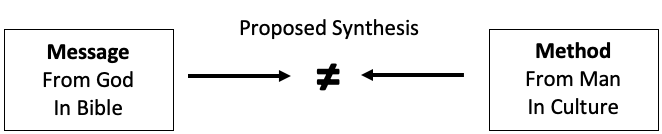
  • The message comes from the Bible—often something like the Roman Road, the Four Laws, or Bridge to Life
  • The method comes from culture—whatever the practitioner decides is best in his or her cultural situation

The result of this synthesis of ideas was a dialectic somewhat as follows:

The reader may want to consider that, by definition, dialectics seeks to “resolve the conflict of two contradictory ideas.” Often verbs used to describe this amalgamation of differing or opposing concepts are conflate, integrate, and synthesize.

In the above scenario, the methods of evangelism are only as solid or fanciful as the practitioner. For this reason, methodologies are posited from many different directions. We studied Relationship Evangelism, Lifestyle Evangelism, Apologetic Evangelism, Discipleship Evangelism, and Servant Evangelism. Most recently added to this always growing list is Social Justice Evangelism.*

In addition, many of these practitioners disagreed with one another. There reasons for preferring their approach were usually immersed in pragmatism. “Use my method because it really works!”

Some practitioners even experiment with advocating multiple approaches. They identify diverse types of evangelism with differing characters in the Bible. Hence, these innovators posit that persons should practice evangelism only as they feel comfortable. “It is better,” they say, “to have people try something in evangelism than to do nothing.” A noble goal indeed!

All along, the same presupposition prevails. The Bible does not instruct in methodology of evangelism. Rather, Christ in His Word depicts multiform methodologies according to the presuppositions of practitioners and/or the comfort-level of the doers.

When I discovered the verb “evangelize” three times in my French Louis Segond Revisée Genève (1979), I became confused. Why had I not learned that this verb existed in the Bible? Soon the veil of cultural-conformity was removed from the practice of evangelism. Was there really a biblical verb that helped describe true biblical evangelism? Yes, it was the verb “evangelize” (εὐαγγελίζω).

Through further study, I found that this same Greek verb (behind the three French translations) was actually used 55 times in the New Testament. My curiosity was piqued. Perhaps the Bible did have something definitive to say about ever-conflicting views of evangelism methodology.

The shifting sands of Dialectic Evangelism, as taught by the sirens of culture, were excavated and substituted with the bedrock of teachings and examples from the Bible. Divine propositions replaced human intuition and insight. The removal of the dialectical element returns control of the proclamation of the gospel to Jesus Christ:

No matter how eloquent, cogent, or godly the practitioner, human frailties cannot help but muddy the waters of Great Commission activity. It is dangerous to expose the accomplishment of the Great Commission to the volatilities of human intuition. No matter how godly the practitioner, there is always the risk of shift or drift. 

Therefore, no matter how appealing, we must avoid Dialectic Evangelism whenever we recognize it. Only the biblical methodology of gospelizing perfectly synthesizes with the biblical message of the gospel.

Whatever the means, dialectic, synthesis, or integration, it is important to avoid diluting Scripture through misplaced practice.

For this reason, I am very grateful that some Evangelical Statements of Faith affirm that the Bible is inerrant in matters of both “Faith and Practice.” God makes no mistakes in communicating His gospel message. Nor does He lack in providing necessary training in how to propagate that message.

In these past ten years it has been my experience to see an increase in the practice of biblical evangelism—even as it has been under attack. Practitioners of biblical evangelism must keep pressing on. Follow the divine examples and teachings of Jesus and the apostles. There is no need to synthesize a dialectic with worldly ways.

- - - - -

*Biblical alternatives to more human approaches to evangelism may be termed: Expectant Evangelism, Initiative Evangelism, Biblical Evangelism, New Testament Evangelism, Direct Evangelism, Active Evangelism, Street Evangelism, Door-to-Door Evangelism, Street Preaching, Open-Air Preaching, Searching for Houses of Peace, Winning Disciples, Disciple-Making, and Soul-Winning.

Tuesday, December 29, 2020

Evangelism—The Christian’s Blessed Obligation!


It is indeed a great honor to evangelize others as followers of Christ. When we disown Christ before others, we bring shame on ourselves and our Savior. Evangelizing is one of those difficult blessings in the Christian life. It is a blessed obligation. Telling of Jesus results in the treasures of heaven opening before us. And yet it is often a struggle. “The Spirit is willing, but the flesh is weak.”

Promises and Blessings

God lovingly goads and guides us by promises and warnings. He clearly lays out the blessings of evangelizing:

  1. The name of Christ is lifted up. 
  2. Our spirits are lifted heavenward as we declare the name of Jesus. 
  3. The power of Satan is diminished on earth. 
  4. Lost souls hear of the only Savior of the world
  5. The Holy Spirit works in-with-and-by the Word of God to call for men to repent and believe.
  6. Supernaturally, some hearers do repent and believe. 
  7. All heaven rejoices when one sinner repents. 

All these good things happen, and only happen, when Christ’s name is openly and outwardly proclaimed—in the midst of an antagonistic and rejecting world.

Warnings and Judgments

Often the promise is not enough. Until we really engage in direct evangelism—street evangelism, door-to-door, etc.—we do not experience these above blessings. We rarely even think that they really exist, because they do not correspond to our human apprehensions. So, God provides warnings and judgments as goads to move us outside our comfort zone. He prods us, wanting us to evangelize in obedience to His will, command, and desire.

Luke 17

Luke 17 details an interesting story in the life of Jesus where He healed ten lepers. All ten lifted up their voices in unison and said, “Jesus, have mercy on us!” (Luke 17:13). Jesus commanded them saying “Go, show yourselves to the priests.” As they went, the narrative records that, “as they went, they were cleansed.” (Luke 17:14).

And yet only one of them, being healed from this incurable disease, returned and glorified God with a loud voice. He fell on his face before Jesus in gratitude, giving Him thanks. Then Jesus gave His analysis of the results of this healing:

“Then Jesus said, ‘Were not ten cleansed? Where are the nine? Didn’t any return to give glory to God except this foreigner?’ And he told him, ‘Get up and go on your way. Your faith has saved you.’” Luke 17:17-19 (CSB).

All ten were healed of their incurable disease of leprosy. Yet only one was healed of the incurable guilt of his sin. All ten reached out to the proper person, Jesus. All ten said the same words, “Have mercy on us!” Yet only one received the ultimate mercy that he really needed—being washed of his sin-soaked-condition.

What made the difference?

  1. He returned to thank the One who had delivered him
  2. He gave glory to God for what Jesus had done
  3. He fell facedown at the feet of Jesus, thanking Him.

The one leper gave open-outward-and-unashamed glory to God for his healing. He was not ashamed of his former state nor of the One who healed him. He therefore received from the Lord Jesus a spiritual and eternal healing.

John 9

This same pattern held true for the man born blind in John 9. In his case, after the man born blind was abandoned by his parents. He was ridiculed and reviled by the Pharisees. They cast him out of their presence.

It appears that Jesus waited for the moment of his exclusion to act. After he was rejected, Jesus made a search for him and found him. The Lord Jesus confirmed the steadfastness with which he testified of his healing. Here is their fascinating interchange:

  • Jesus heard that they had cast him out; and when He had found him, He said to him, “Do you believe in the Son of God?”
  • He answered and said, “Who is He, Lord, that I may believe in Him?”
  • And Jesus said to him, “You have both seen Him and it is He who is talking with you.”
  • Then he said, “Lord, I believe!” And he worshiped Him. John 9:35-38 (NKJ)

This man born blind was healed by Jesus. He had not seen who had anointed his eyes with clay. Jesus reached out to him after he was rejected by men. When Jesus spoke His true identity, his immediately response were the words, “Lord, I believe.” He fell his knees and worshipped Jesus.

It is unmistakable. Persecution or no persecution. Open and outward profession of faith in Jesus Christ coalesce in the conversion process. Salvation partners with the praise of the soul to bring glory out of the mouth of the converted. There is no exception. True salvation leads to true praise of Him who saves.

Mark 8

Jesus left us a stern warning at the end of Mark 8:

“For whoever is ashamed of Me and My words in this adulterous and sinful generation, of him the Son of Man also will be ashamed when He comes in the glory of His Father with the holy angels.” Mark 8:38 (NKJ).

Shame leads to shame. Of the several parallel passages, only Mark specifies the earthly audience. “Whoever is ashamed of Me and My words in this adulterous and sinful generation.” There is a necessity to stand apart from the world and its conceptions. The follower of Christ is to give Him glory even in the midst of an adulterous and sinful generation.

John 12

Many of the rulers in John 12 were unwilling to pay the price. Coming out for Jesus was not an option for them. They preferred their privatized religious experience. John the Apostle, writing with divine clarity, condemned them for their half-hearted faith:

“Nevertheless even among the rulers many believed in Him, but because of the Pharisees they did not confess Him, lest they should be put out of the synagogue; for they loved the praise of men more than the praise of God.” John 12:42-43 (NKJ).

Moral requirement? Moral obligation? Moral duty? These rulers, men like Nicodemus and Joseph of Arimathea, believed in Jesus—but secretly. They thought it better to hide their faith than to openly confess Jesus before men. They had the sickness of believing without confessing!

John was not too kind in diagnosing their ailment. They had a misplaced love-affair. Their love was for the praise of the world more than it was for the praise of God.

This bleak appraisal of John can help us understand the following words of Jesus with greater contextual clarity:

“Therefore whoever confesses Me before men, him I will also confess before My Father who is in heaven. But whoever denies Me before men, him I will also deny before My Father who is in heaven.” Matt 10:32-33 (NKJ).

“Also I say to you, whoever confesses Me before men, him the Son of Man also will confess before the angels of God. But he who denies Me before men will be denied before the angels of God. Luke 12:8-9 (NKJ).

“For whoever is ashamed of Me and My words, of him the Son of Man will be ashamed when He comes in His own glory, and in His Father’s, and of the holy angels.” Luke 9:26 (NKJ).

So, while evangelizing is not:

  • The trigger of our salvation
  • The effective cause of our salvation.

Evangelism is:

  • The initial confession of our salvation
  • A grateful aggregate to our salvation
  • A necessary action proceeding from our salvation
  • A constantly coexistent result of our salvation.

Is evangelizing commanded in the Great Commission? Yes, it is. Is evangelizing exemplified in the Gospels and the Book of Acts? Yes, it is. Is evangelizing discussed within the New Testament epistles? Yes, it is.

Let every reader consider owning these words of Paul in 1 Corinthians:

“For if I evangelize, I have nothing to boast of, for I am under compulsion; for woe is me if I evangelize not! For if I do this willingly, I have a reward; but if against my will, I have been entrusted with a stewardship.” 1 Cor 9:16-17 (translation mine).

Sometimes we evangelize willingly and are rewarded with great joy. At other times we evangelize against our will. In either case, we humbly obey. We gladly follow our Master Jesus who said, “I must evangelize.” Luke 4:43 [εὐαγγελίσασθαί με δεῖ]!

Monday, September 7, 2020

Understanding God’s Rhetorical Question

“Who will give them such a heart to be in them 
that they would fear me and keep my commands all days, 
in order that it may go well with them and their sons forever?” 
Deut 5:29 (Lexham)

Right on the heels of the request of the elders of Israel for a Mediator (Moses > Jesus) in Deut 5:23-28, which request God determined was “good,” God then advanced the need for Someone (the Holy Spirit) to give His people a new heart (and hence the New Birth), Deut 5:29.

When handwriting or reading Deuteronomy, the request for a mediator is unexpected, but understandable. God used pyrotechnics on the mountain as He recited the Ten Commandments. The people rejected this unbuffered broadcast from God. God’s response was even more startling, “they are right in all that they have spoken.” Deut 5:28. The elders of Israel were requesting a mediator. Without knowing it, the were ultimately asking for the one and only Mediator between God and man, the man, Christ Jesus.

With growing curiosity comes the next verse. In this verse God rhetorically requests a person or Person. Deuteronomy 5:29 begins with the interrogative pronoun מִי (mi, meaning who?), which is translated in the Greek Septuagint (LXX) as τίς (meaning who, what, how). Verse 29 is translated in the Lexham Translation of the LXX, “Who will give them such a heart to be in them?”

“Who will give them such a heart to be in them?”

This verse thematically parallels Ezekiel 36:25-27, speaking of New Covenant new birth:

“Then I will sprinkle clean water on you, and you shall be clean; I will cleanse you from all your filthiness and from all your idols. I will give you a new heart and put a new spirit within you; I will take the heart of stone out of your flesh and give you a heart of flesh. I will put My Spirit within you and cause you to walk in My statutes, and you will keep My judgments and do them.” Ezek 36:25-27 (NKJV).

The similarities are intense. The Holy Spirit inspired Ezekiel to answer God’s rhetorical question in Deuteronomy 5:29. The who? was the Holy Spirit. He would accomplish a new work “within the heart” of those who received His teaching. This work was to be accomplished by “My Spirit,” said the Lord God. God the Father asked the Holy Spirit to savingly work on His behalf for the sake of His people off the pens of Moses and Ezekiel.

God the Father asked the Holy Spirit to savingly work on His behalf for the sake of His people off the pens of Moses and Ezekiel.

Returning to Deuteronomy 5:29. Some astonishing clarity is communicated from the mouth of the Lord God. First of all, a Giver implies a gift. A gift is unearned and undeserved. A gift is free. It is given by grace alone. Second is the location of this giving activity. God’s request was for this outside party to accomplish His work in “their hearts” (plural) and “within them” (plural). God was requesting inner work—in the heart and soul of the individuals concerned—the dividing of their joints and marrow. The resulting transformation was not the activity of those receiving the heart transplant. They would only receive a new nature and become a new creation by the outside the work of the Holy Spirit.

Third, the first result of this inner change orchestrated by God but accomplished by the Holy Spirit was to give them a fear of God. “That they would fear me.” The implication of this verb appears to be a present continuous. There is the beginning of the fear of God, leading to repentance and faith. Then there is the continuation of the fear of God leading to sanctification and obedience.

Fourth, the Spirit of God residing within the people of God would assist them to “keep all My commandments.” This concept was amplified by Ezekiel in the startling verse, “I will put My Spirit within you and cause you to walk in My statutes, and you will keep My judgments and do them.” Ezek 36:27. God’s Holy Spirit heart-change within the people of God would "cause" them to observe His commandments!

God’s Holy Spirit heart-change within the people of God would "cause" them to observe His commandments!

Fifth came the blessing, “that it might go well with them and their sons forever.” Consider the two elements in this clause. First, the “good” in this phrase is picked up as the “eu” in the verb “evangelize” and Evangel. The announcement of this good work of the Holy Spirit was and is “Good News”—it is the Gospel of salvation. This message of Good News goes forth that it may “go well” with others. The Hebrew verb יָטַב (to be good) was translated into Greek as the adverb εὖ (good) and the verb εἰμί (to be). Here in Deuteronomy 5:29 comes the “Good” of the “Good News of Jesus Christ"!

Here in Deuteronomy 5:29 comes the “Good” of the “Good News of Jesus Christ"!

The Apostle Paul may have been thinking about Deuteronomy 5:29 when speaking to the jailer in Philippi. The jailer asked, “Sirs, what must I do to be saved?” Acts 16:30. So Paul quickly answered, “Believe in the Lord Jesus Christ, and you will be saved, you and your household.” Acts 16:31. In his response, Paul jumped from believing in Jesus to its end result as found in Deuteronomy 5:29, “that it might go well with them and their sons forever.” Thus he said to the Philippian jailer, “and you [yourself] will be saved” adding “and your household.”

God, therefore, right after the giving of the Ten Commandments in Deuteronomy 5, foreshadowed Jesus as Mediator of a better covenant (Deut 5:28) and petitioned the work of His Holy Spirit (Deut 5:29). God explained the basic elements of the gift of the New Birth. He described the gift of salvation from an exterior Giver, who first gives the fear of God, and then the ability to obey His commandments. In the New Covenant, the Holy Spirit answered God's appeal in Deuteronomy 5. He alone gives inner transformation to God’s called people.