Showing posts with label Street Evangelism. Show all posts

Saturday, March 6, 2021

Unmasking Dialectical Evangelism


In seminary and for the several years of my post-seminary career, I considered Dialectical Evangelism the only type of evangelism available:

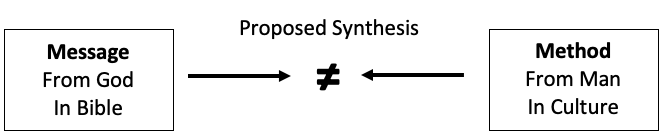
  • The message comes from the Bible—often something like the Roman Road, the Four Laws, or Bridge to Life
  • The method comes from culture—whatever the practitioner decides is best in his or her cultural situation

The result of this synthesis of ideas was a dialectic somewhat as follows:

The reader may want to consider that, by definition, dialectics seeks to “resolve the conflict of two contradictory ideas.” Often verbs used to describe this amalgamation of differing or opposing concepts are conflate, integrate, and synthesize.

In the above scenario, the methods of evangelism are only as solid or fanciful as the practitioner. For this reason, methodologies are posited from many different directions. We studied Relationship Evangelism, Lifestyle Evangelism, Apologetic Evangelism, Discipleship Evangelism, and Servant Evangelism. Most recently added to this always growing list is Social Justice Evangelism.*

In addition, many of these practitioners disagreed with one another. There reasons for preferring their approach were usually immersed in pragmatism. “Use my method because it really works!”

Some practitioners even experiment with advocating multiple approaches. They identify diverse types of evangelism with differing characters in the Bible. Hence, these innovators posit that persons should practice evangelism only as they feel comfortable. “It is better,” they say, “to have people try something in evangelism than to do nothing.” A noble goal indeed!

All along, the same presupposition prevails. The Bible does not instruct in methodology of evangelism. Rather, Christ in His Word depicts multiform methodologies according to the presuppositions of practitioners and/or the comfort-level of the doers.

When I discovered the verb “evangelize” three times in my French Louis Segond Revisée Genève (1979), I became confused. Why had I not learned that this verb existed in the Bible? Soon the veil of cultural-conformity was removed from the practice of evangelism. Was there really a biblical verb that helped describe true biblical evangelism? Yes, it was the verb “evangelize” (εὐαγγελίζω).

Through further study, I found that this same Greek verb (behind the three French translations) was actually used 55 times in the New Testament. My curiosity was piqued. Perhaps the Bible did have something definitive to say about ever-conflicting views of evangelism methodology.

The shifting sands of Dialectic Evangelism, as taught by the sirens of culture, were excavated and substituted with the bedrock of teachings and examples from the Bible. Divine propositions replaced human intuition and insight. The removal of the dialectical element returns control of the proclamation of the gospel to Jesus Christ:

No matter how eloquent, cogent, or godly the practitioner, human frailties cannot help but muddy the waters of Great Commission activity. It is dangerous to expose the accomplishment of the Great Commission to the volatilities of human intuition. No matter how godly the practitioner, there is always the risk of shift or drift. 

Therefore, no matter how appealing, we must avoid Dialectic Evangelism whenever we recognize it. Only the biblical methodology of gospelizing perfectly synthesizes with the biblical message of the gospel.

Whatever the means, dialectic, synthesis, or integration, it is important to avoid diluting Scripture through misplaced practice.

For this reason, I am very grateful that some Evangelical Statements of Faith affirm that the Bible is inerrant in matters of both “Faith and Practice.” God makes no mistakes in communicating His gospel message. Nor does He lack in providing necessary training in how to propagate that message.

In these past ten years it has been my experience to see an increase in the practice of biblical evangelism—even as it has been under attack. Practitioners of biblical evangelism must keep pressing on. Follow the divine examples and teachings of Jesus and the apostles. There is no need to synthesize a dialectic with worldly ways.

- - - - -

*Biblical alternatives to more human approaches to evangelism may be termed: Expectant Evangelism, Initiative Evangelism, Biblical Evangelism, New Testament Evangelism, Direct Evangelism, Active Evangelism, Street Evangelism, Door-to-Door Evangelism, Street Preaching, Open-Air Preaching, Searching for Houses of Peace, Winning Disciples, Disciple-Making, and Soul-Winning.

Wednesday, June 10, 2020

Evangelizology: Diagnosing the Disease of Many Questions

Evangelizology: Diagnosing the Disease of Many Questions: Sometimes in street evangelism, in the local church, or even in the classroom settings I encounter persons who pepper me with tangentia...

Diagnosing the Disease of Many Questions


Sometimes in street evangelism, in the local church, or even in the classroom settings I encounter persons who pepper me with tangential questions. I barely construct an answer to their first question when very soon another one arises. In many cases, clear biblical answers do not bring them peace. They seem to be plagued with a specific ailment—the sickness of many questions.
Paul helped Timothy diagnose this disease in persons who sometimes make their way into local churches.
“If anyone teaches otherwise, and assents not to healthful words, those of our Lord Jesus Christ, and to the teaching which is according to godliness, he is puffed up, knowing nothing, but is morbid about questions and strifes of words, from which come envy, strife, railings, evil surmisings, wranglings of men corrupted in mind, and robbed of the truth, supposing that godliness is a means of gain.” 1 Tim 6:3-5-ABPS (1913).
There exists a “morbidity about questions” as this translation puts it—or a “sickness of trifling questions.” The prognosis of this ailment implies that those struck by this disease either ignore that they have it or cannot remedy their antagonistic cognitive thunderstorms.
They convulse under the spell of an epilepsy of doubt. Never satisfied with any answer from the Bible, their “pride of life” retrieves another juicy bone of contention to overwhelm their hopeful spiritual benefactor. Are these not the “wells without water and the clouds carried by the tempest” as described by Peter (2 Pet 2:17-NKJ)?
Who are these quasi-Christians beset with this deadly disease? How can they be vetted? Is there hope for them?
These quasi-Christians sound smart. They position themselves as brilliant, using Pyrrhonic logic they destroy any and all propositions made about God or man. They cloak themselves as contemporary Voltaire’s or David Hume’s. “They have set their mouth against the heavens, and their tongue walks through the earth” (Psa 73:9).
Did Peter temporarily suffer from this ailment when he reproved the Lord Jesus in Matthew 18:22? Did not pride swell his heart after God had revealed to him the true identity of Jesus?
In an interesting portion of Deuteronomy 29, God through Moses described a disease in this same family:
“So that there may not be among you man or woman or family or tribe, whose heart turns away today from the Lord our God, to go and serve the gods of these nations, and that there may not be among you a root bearing bitterness or wormwood; and so it may not happen, when he hears the words of this curse, that he blesses himself in his heart, saying, ‘I shall have peace, even though I follow the dictates of my heart’—as though the drunkard could be included with the sober.” Deut 29:18-19.
At the root of this disease called “wormwood” was total selfishness and pride: “I shall follow the dictates of my own heart!”
God does not tolerate this ailment. He promised that he would forcefully remove this diseased branch. “The Lord would blot out his name from under heaven.” (Deut 29:20). Likewise, Jesus borrowed the punishment language of Moses in John 15:
“If anyone does not abide in Me, he is cast out as a branch and is withered; and they gather them and throw them into the fire, and they are burned.” John 15:6.
Meanwhile, quasi-Christians with this disease of disputes act as Christians and prey on Christians. It’s a game for them! Knowing the right words, they lack the necessary broken and contrite heart. They will not submit to the clear teachings of the Bible. Nor have they repented of their own total inability to save themselves. Rather they prefer their own imaginations about salvation. This disease is deadly!
People have honest questions. An honest question deserve a sincere answer--even if the answer is, “I don’t know.” But then, there is the disease of many questions. The attentive Christian, “wise as a serpent,” should early differentiate between the contrite heart and the crafty soul.
When recognized, Paul gave the admonition that the diseased person should be shunned after a first and second encounter.
“But avoid foolish disputes, genealogies, contentions, and strivings about the law; for they are unprofitable and useless. Reject a divisive man after the first and second admonition, knowing that such a person is warped and sinning, being self-condemned.” Titus 3:9-11.
Yet is there hope for such a quasi-Christian? Yes. Paul also held out an olive branch of expectation.
“And if anyone does not obey our word in this epistle, note that person and do not keep company with him, that he may be ashamed. Yet do not count him as an enemy, but admonish him as a brother.” 2 Thess 3:14-15.
Clearly, Paul’s response to a factious man was not a public burning at the stake. Rather, he held out the hope that this person might repent and accept admonishment.
Likewise, a discussion of the disease of many questions demands our godly introspection:
  • Does your heart churn with antagonism and contradiction as you read and meditate on the teachings of the Bible?
  • Is your heart quieted by the reproofs and promises of God’s words?

Certainly, if our heart is churning and chaffing against the Bible’s admonitions, then we have soul-searching to do. We ought not rest until we have repented of our sin of pride, and humbly submitted to God who speaks perfectly in, with, and by His Holy words.
If a brother or sister in our church appears struck with this ailment, reach out to them one time, then a second time. No more. Do not allow yourself to be caught in their trap, picking up their dreadful disease. After two encounters we can do no more. We must obey the teachings of Paul.
Deliver us, Lord, from the disease of many questions.


Sunday, May 19, 2019

A Holy Moment in Brazil


We crossed a small bridge walkway from the sidewalk to enter into the house of W___, a blind man. He and his wife were waiting for us. Their São Paulo living room was furnished with three sofas organized in a u-shape and a small coffee table in the center. Although there was five of us visiting from the local Baptist church, W___ and his wife seemed very pleased to welcome us.
The conversation consisted of Portuguese words of welcome and thanks. Being the lone “American on a Mission Trip” in the group, it was not long before everyone looked to me to lead the conversation. What was I going to say?
Speaking through a gifted interpreter, I told W___ that we were visiting him in the name of Jesus. I asked him if I could begin by sharing something that had happened to me in 1980. He said, “Yes.” Following his approval, I explained that I had believed in Jesus from a young age. And though I believed in Jesus I was still injured in a train-truck collision at the age of 19. One day, as I worked as a garbageman, our truck stalled on the railroad tracks right in front of a freight train.
The collision left me in a coma for 8 days. It took me almost a year to recuperate and to begin sorting out my post-accident life. People told me that I should feel fortunate that I was still alive. They explained that I could have died. Rather than accepting their encouragement, I was inwardly mad at God. Why had God allowed me that trauma, pain, and embarrassment? 
I asked W___ a question:
“How have you responded to God regarding your blindness? Have you struggled with God like I have?”
As W___ shared his story, a torrent of tears began to flow from this large man in his 40s. He removed his mirrored-lens glasses and wiped his eyes. Apparently, he also had been in an accident at the age of 19. It was a motorcycle accident. He broke both his legs. He explained to us that as he lay in his hospital bed, he told God, “If you get me out of here, I will serve you for the rest of my life!”
After being released from the hospital W___ quickly returned to drinking with his friends. One month later, while he was getting drunk in a bar with his friends, W___ remembered his promise to God. Soon after he gradually began to lose his eyesight. W___ was under deep conviction, sobbing as he shared. He felt that God had punished him with blindness because he did not keep his hospital promise to God.
I asked W___ if he knew that the last words of Jesus on the cross were, “It is finished!” (John 19:38). I continued, “Do you know what was finished?” I used these words to explain the essence of the gospel. Jesus lived a perfect-sinless life. He obeyed all the laws of the Old Testament. Then, when He died on the cross, as a substitute for our sins. Jesus paid for all the sins of W___ sins full and free. He did it all! All of W___’s sins past, present, and future were carried away by the blood of Jesus. And in their place, the righteousness of Christ was given to all those who repent of their sins and believe in Jesus Christ as their Lord and Savior. 
I asked W___ the question, “W___, if you died tonight are you absolutely sure you would get into heaven?” He answered, “No.” I continued, “W___, if Jesus said, ‘Why should I let you into My heaven?’ what would you answer?” He said, “I would say, ‘Even if you don’t let me in, I will still believe in You!’”
We were all moved by W___’s humble and broken heart. The missionary who was with us explained the steps of repentance and faith in Portuguese. W___ and his wife tearfully repented and believed. Their tears of grief became tears of joy!
A holy moment transpired around those three sofas. It was definitely a God-moment. The glory of God seemed to glow in the tiny room as the name Jesus was lifted up.
After leaving the house of W___, we ascended his road to a commercial street on the crest of the hill. Once there we began handing out gospel tracts and engaging persons in gospel conversations.
As we walked the commercial street sharing the gospel another unusual conversation took place. We were walking as a group—four men and one woman handing out tracts. Suddenly a young woman named D___ came up to us and said, “I want to be saved!” I pulled out a gospel tract and began to explain the gospel. She said, “I really want to be saved.” At that moment I considered that someone else had spoken with her on one of the four other days that we had evangelized on that street. D___ appeared to be under strong conviction. I asked her if she was ready to repent of her sins and confess Jesus as her Savior and Lord right now. She said, “Yes.” D___ prayed a prayed of repentance and faith.
In about an hour of evangelism God gave us two amazing and memorable conversations. The lives of W___ and D___ were eternally touched by the gospel of Jesus Christ.
In like manner, Peter answered the question of Jesus:
“Lord, to whom shall we go? You have the words of eternal life. Also we have come to believe and know that You are the Christ, the Son of the living God.(John 6:68-69).
On that day in Brazil, we experienced eternity touching the earth through the words of Christ!

Thursday, April 25, 2019

Seven signals of revival in our time

Although not qualified to speak of the revival of biblical Christianity in other language groups across the world, in the English-speaking U.S., these past 10-20 years, there seems to exist an unusual movement of the Holy Spirit. Could it be that God is allowing us to live in the midst of a spiritual awakening?
Here is a list of seven pointers portraying God’s favor upon His people in North America. These signs are organized in a chronological manner, as, in God’s providential oversight, each builds upon the other:
1. Incredible electronic Bible study software are available and being used. These software packages are self-supporting and compete with one another to provide better usability and power in Bible study!
2. New conference venues have sprouted up, such as the Foundations Conference, Founders Conference, Passion Conference, and T4G. These conferences highlight the Five Solas of the Protestant Reformation and promote biblical Christianity.
3. YouTube, Podcasts, and Vimeo promote the revival of expository preaching online.
4. New ministry associations have developed, such as Acts 29, 9Marks, The Gospel Coalition, Teaching Leaders International, and NoPlaceLeftBehind.
5. Doctrinally-rich music is being written, new hymnals are being produced, and Internet music channels are now available that highlight doctrinally-rich music—Sound+Doctrine. Songs have been written by LeCrae, members of Click116, the Getty’s, Derek Webb, Eric Schumacher, and David L. Ward—all emphasizing sound doctrine.
6. A new thrust of young street evangelists and those aggressively “searching for persons of peace” has begun to mark the land. Biblical methods of evangelism are realigning its practice across North America!
7. Antagonism to the gospel and to the many teachings of the Bible is on the increase. Satan is aggressively targeting the ministry leaders of all these newly formed groups.
Is Holy Spirit revival sweeping the land? It may very well be!

Saturday, March 3, 2018

On the Very Words of the Bible: Experiencing God's Holy Presence in the Midst of Conversation!


In the past several weeks of evangelism we have encountered the special presence of God entering evangelism conversations when the Bible has been opened. These past two Thursdays I have partnered in initiative evangelism with a Midwestern student named D. J.
On both Thursdays something similar happened. I engaged a person in a gospel conversation. Typical questions came off my tongue:
  • “Have you heard about Jesus?”
  • “What do you think of Jesus?”
  • “Has there been a time in your life when you have asked Jesus to forgive you of your sins?”
  • “Could you tell me about it?”
  • “Has the Lord given you a local church that you attend?”

Moving from these questions conversations either proceeded toward Jesus and the gospel or came to an end. My goal is threefold:
  1. To understand if the person has a genuine relationship with Christ.
  2. To seek out if the person has a hearing of faith as it relates to the Word of God.
  3. To discern the person’s readiness for repentance and faith.

Something noteworthy happened these past two weeks. When I was at the point of concluding a conversation that was becoming unfruitful, D. J. asked a question:
  • “Can I show you something in the Bible?”

In both cases the individual said, “Yes!” Thereupon, D. J. opened his Bible and showed them a verse that he had discerned would be helpful for the person to hear in light of the former conversation. And in both cases, it happened—God came down on the conversation!
It was as if God Himself had stepped down onto the street beside us.
The focus shifted from my words, from the gospel tract, and from any of my conversational attempts, to the words in the Bible itself. In both cases conviction came down upon the listeners. They suddenly became attentive and submissive to the words of God’s Word. It was beautiful to see!
We experienced this with Wilma two Thursdays ago. She had indicated that she had a relationship with Christ, but the conversation was going nowhere. D. J., however, showed her 1 Corinthians 6:19-20:
“Or do you not know that your body is the temple of the Holy Spirit, whom you have from God, and you are not your own? For you were bought at a price; therefore glorify God in your body and in your spirit, which are God’s.” 1 Corinthians 6:19-20.
The Holy Spirit came down and anointed those words, and we felt the presence of God. Wilma received D. J.’s admonition from God’s Word and he prayed for her.
We met A J. this past Thursday. Seeing that we were Christians, A. J. was aggressively asking us for money. D. J. opened his Bible to James 2 and read:
“But someone will say, ‘You have faith, and I have works.’ Show me your faith without your works, and I will show you my faith by my works. You believe that there is one God. You do well. Even the demons believe—and tremble!” James 2:18-19.
After D. J. read verse 18, A. J. said, “That’s what I’m talking about!” But D. J. kept reading. Verse 19 contained the warning. D. J. showed him that the important thing was not just believing, but living out that belief. A. J. was immediately humbled by the words of the Word of God. He said, “Now that’s true! I know that’s true!” Apparently, God revealed to A. J. that he was not living out the faith that he claimed. His immediate humility was remarkable. We prayed for him on the street outside the liquor store.
In both cases, in the hallway of an apartment building and outside a liquor store, God’s presence came down. When the Bible was opened and the words of God were read, His presence was definitely felt.

“For the word of God is living and powerful, and sharper than any two-edged sword, piercing even to the division of soul and spirit, and of joints and marrow, and is a discerner of the thoughts and intents of the heart.” Hebrews 4:12.

Saturday, November 25, 2017

Evangelism as Spiritual Wrestling

Wrestling was definitely the most difficult sport that I experienced. Wrestling pits one wrestler against another. No one else can be blamed for a loss. Either the wrestler beats his opponent, or he loses. There is no middle ground. Tie matches in evangelism go into overtime. So, in the end, a tie match in wrestling is extremely rare. Each whistle of every period of a wrestling match tests the skills of two wrestlers going head-to-head.
The sport of wrestling provides an interesting comparative to evangelism. This article will address some of these similitudes. Perhaps applying this analogy will elicit further important spiritual insights to the reader.
(1) Just like wrestling, learning evangelism not a large group activity, it’s one-on-one.
Learning to share the gospel is a one-on-one activity. Where there are some large group or small group aspects to teaching evangelism, like wrestling, it is only effectively learned when being practiced one-on-one. In wrestling, there is no shortcut to the need for practicing wrestling moves on an opponent. Likewise, there is no shortcut to experiencing evangelism. The Christian must encounter responses to various concepts. It is only when hearing these reactions that the Christian can grow in understanding how best to give an answer. These lessons cannot be learned in the one-way communication of a large group setting. Once the Christian experiences, understands, and properly replies to individuals, then they become lessons he can apply to the large group settings. Learning evangelism is a one-on-one activity.
(2) Learning evangelism, like wrestling, focuses on application.
Much like the words of Jesus in the Great Commission in Matthew, wrestling is “teaching to obey.” Matthew 28:20. When a person makes this move, you need to counter with that move. If your opponent leans too heavily on this foot, then you can use an Ankle Pick on that foot. If your opponent drops his head, he might be a prime candidate for a Reverse Cradle. In each move, your opponent opens the door to a panorama of countermoves.
Similarly in personal evangelism, the Christian attacks the principalities and powers of evil. He experiences the need for the moves and countermoves provided in the Bible. It is as he “sits on thorns” and “dwells among scorpions” that he learns not to fear them:
“And you, son of man, do not be afraid of them nor be afraid of their words, though briers and thorns are with you and you dwell among scorpions; do not be afraid of their words or dismayed by their looks, though they are a rebellious house.” Ezekiel 2:6.
One-on-one evangelism acts as spiritual bodybuilding. The Christian’s forehead grows stronger than his opponent’s forehead:
“Behold, I have made your face strong against their faces, and your forehead strong against their foreheads. Like adamant stone, harder than flint, I have made your forehead; do not be afraid of them, nor be dismayed at their looks, though they are a rebellious house.” Ezekiel 3:8-9.
It is by one-on-one contact with opponents of the gospel that the power and beauty of the gospel become evident. These lessons can only be learned through one-on-one evangelistic encounters.
Evangelism, like wrestling, involves “teaching to obey.” Jesus inseparably linked teaching and obedience. Teaching is confirmed and fructified by the practice of obedience. Both are non-negotiable parts of spiritual learning.
(3) There is a goal in wrestling, just as there is a goal in evangelism.
The goal in wrestling is to win the match. In order to win the match, the wrestler must take down his opponent in the first period. In the second period, his goal is to reverse his opponent if he is found in the bottom position. If in the top position, the wrestler’s goal is to apply a pining combination on his opponent. He can earn back points or he can pin his opponent. In the end, the wrestler wants the referee to raise his hand as the winner at the end of the match.
In evangelism, as the Christian wrestles against the principalities and powers of sin and false ideas. His goal is to win the other person to Christ. He makes every effort, using every argument that comes to his mind, guiding the contact to every Bible verse that is available to him at the time, that the contact may repent and believe the gospel. His is in a spiritual wrestling match. Yes, there will be a raising and a lowering of hands at the end of life. The Christian wants everyone that he can to be won to Christ, so that they will have the victory of Jesus transferred over their sin debt. The Christian’s goal is to bring every contact to the point of decision.
“To the weak I became as weak, that I might win the weak. I have become all things to all men, that I might by all means save some.” 1 Corinthians 9:22.
(4) More participatory than spectator.
Wrestling is not so much a spectator sport. Yes, perhaps “Big Time Wrestling” gets crowds. But nitty-gritty high school and college wresting does not attract large crowds like other sports. Wresting is not a sport to be enjoyed. It is rather a sport that forms individual discipline, character, and drive.
Quite similarly, evangelism is best when it is not done to be seen by others. True evangelism is most powerful when the Great Commission is applied out of sheer obedience to the Master, without any view to human accolades from other Christians. The unsaved perceive a phony evangelist. God does not encourage us to seek to win brownie points with men. Evangelism is best when, like prayer, it is acted upon with a sole audience of God—along with the person with whom we are seeking to share the gospel.
(5) Like wrestling is best learned in one on one practice and matches, so evangelism.
Other than conditioning, the most important part of wrestling practice is found in pairing up with a teammate of a similar weight, and working through moves with that teammate. After the practice of the move, then the effort applied to the move goes to half-go. Then, finally, when in order to fully learn the move, the opponent needs to fully fight the move. Only when practicing full-go are the moves and countermoves really learned.
In evangelism, there is a need for a mentor to take out the learner and show him how to start gospel conversations. The fellow Christian sees his mentor share the gospel, and learns how people respond to certain questions and comments. He begins to emulate his trainer. Soon he is comfortable sharing the gospel, and he can begin to train someone else. Yes, evangelism is best learned through being paired up two-by-two sharing the gospel in initiative situations, where one person can be a formal or informal mentor.
(6) The close proximity of wrestling allows for eye-to-eye contact with the enemy.
At the beginning of the wrestling match, the wrestler looks at his opponent in the eye, and the referee raises his hand, and says, “Ready, Wrestle.” With those two words, the match goes live. The two opponents crouch like ferocious beasts seeking to discern their opponent’s vulnerabilities.
So, in evangelism, one sadly encounters those whose lives have been destroyed by the enemy of our souls, Satan. The Christian regularly encounters persons who are caught in the clutches of terrible sins. They have a certain look in their eye. Some have terrible hatred in their eyes and heart as soon as the name Jesus is mentioned. Others are so vehemently antagonistic to the gospel that it appears that there may some form of demonic activity involved. All these types of people are regularly encountered when involved in street evangelism or door-to-door. God uses these negative experiences as reality therapy. The herald is warned of pitfalls to avoid. He observes the enemy’s playbook in operation in other people’s lives. He learns the tricks and moves of his prime enemy, the devil.
(7) The wrestler can apply the moves he has learned in practice with success.
In a wrestling match, the wrestler has the opportunity to learn the power and effectiveness of certain moves against his opponents. I remember when I first used a Sit-Out to get away from an opponent in a match when I was in the bottom of the Referees Position. It worked. I got away from my opponent. Earned two points. Now came the hard work of trying to take him down again. Later I learned that I could use the Sit-Out to lead to a reversal on my opponent. As I practiced, there were certain moves that came to me as if by second nature.
Evangelism takes practice. Yes, evangelism can become second nature to the Christian. He can lovingly and naturally start conversations and move them into the gospel. It is not easy. It requires repetition and constant dedication. But it is possible.
Further, as the Christian uses Sword of the Lord, the Word of God, with success, he becomes more agile in wielding that Sword. He observes the impact of the Word of God. He experiences it melting a heart. He notices the Holy Spirit convicting of sin, judgment, and righteousness. His practice and repetition spur him on.
And lastly, the Christian has the privilege of leading other persons to repent of their sins and place their faith in Jesus Christ. He is there when a person calls on the name of the Lord to be saved. He notes the tears and marks the conviction. He empathizes with the spiritual pain. God gifts the Christian with the opportunity to lead the convicted one to request forgiveness and cry out to follow after Christ. These last occasions are perhaps the most elating experiences of my life. All glory to God!
So, there are some interesting links between evangelism and wrestling.

“Finally, my brethren, be strong in the Lord and in the power of His might. Put on the whole armor of God, that you may be able to stand against the wiles of the devil. For we do not wrestle against flesh and blood, but against principalities, against powers, against the rulers of the darkness of this age, against spiritual hosts of wickedness in the heavenly places.” Ephesians 6:10-12.